# Why Your Indoor Cat Needs Mental Stimulation: The Science Behind Feline Boredom
I want to share something that changed how I think about my cat’s daily routine. A few years back, my vet asked me a simple question: “Does your cat have things to do during the day when you’re at work?” I shrugged it off. “She sleeps, obviously. Cats sleep 16 hours a day, right?”
What I didn’t realize was that my cat wasn’t just resting—she was bored out of her mind. And that boredom? It’s connected to some serious health and behavioral problems that most cat parents never even consider.
## The Hunting Instinct That Can’t Be Ignored
Here’s something fascinating about cats: they’re obligate carnivores with brains built for hunting. Their wild ancestors spent the vast majority of their waking hours stalking, chasing, and catching prey. We’re talking about 50+ hunting attempts per day, each one requiring intense focus, problem-solving, and physical exertion.
Now look at your average indoor cat. She wakes up, eats some kibble from a bowl, licks herself clean, and then… waits. Maybe she stares out the window for a while. Maybe she sleeps in a sunbeam. But those hardwired hunting instincts? They’re completely untapped.
The Cornell University College of Veterinary Medicine has done extensive research on feline behavior, and their findings are sobering. When cats don’t have appropriate outlets for their natural behaviors, stress hormones build up over time. This chronic low-grade stress doesn’t just affect their mood—it literally changes their brain chemistry and immune function.
## The Statistics That Should Wake Every Cat Parent Up
Let me hit you with some numbers that really drove this home for me:
**Behavioral problems:**
– The ASPCA reports that **50% of cats** surrendered to shelters are given up due to behavioral issues
– Destructive scratching, inappropriate elimination, and aggression are the top three reasons for surrender
– Many of these issues are directly linked to stress and understimulation
**Obesity epidemic:**
– An estimated **60% of cats** in the US are overweight or obese, according to the Association for Pet Obesity Prevention
– Indoor cats are **2.5 times more likely** to become overweight than outdoor cats
– The primary culprit? You guessed it—inactivity and overfeeding
**Cognitive decline:**
– A study published in Physiology & Behavior found that cats with limited environmental enrichment showed **measurable cognitive decline** starting as early as age 7
– Enriched cats maintained better problem-solving abilities and memory into their senior years
## What Exactly Is “Mental Stimulation” for Cats?
This is where people get confused. When I say mental stimulation, I don’t mean putting your cat in front of cat TV (though honestly, that can help). I’m talking about activities that engage your cat’s brain and satisfy those hunting instincts.
Think about it this way: in the wild, your cat would have to work for every meal. She’d stalk prey, chase it, catch it, kill it, and then eat it. That’s a multi-step process that requires thinking, planning, and physical execution.
Indoor cats? They walk to their food bowl. Maybe they nibble a few kibbles. Then they walk away. That’s not a meal—that’s a snack delivery service.
## The Puzzle Feeder Revolution
Here’s where things get exciting. Puzzle feeders—interactive toys that require your cat to manipulate them to get food—have been game-changers in the feline enrichment world.
A study conducted by researchers at the University of Edinburgh found that cats using puzzle feeders showed:
– **40% increase in activity levels** compared to bowl-fed cats
– **Reduced stress behaviors** like excessive grooming and pacing
– **Longer duration of feeding behavior**, mimicking natural hunting patterns
– **Better weight management** due to slower eating and increased activity
I’ve tested several with my own cat, and the transformation was remarkable. Within two weeks of switching to puzzle feeders, she was more playful, more alert, and honestly, less of a grump when I came home.
## Simple Enrichment Ideas That Actually Work
You don’t need to spend a fortune or redesign your home. Here are some practical enrichment strategies that have worked for me and countless other cat parents:
**The cardboard box fortress:**
Scatter boxes around your house, especially ones with holes. Cats lose their minds over boxes. It’s been scientifically proven—actually, there’s a study from Utrecht University showing that cats in shelter environments who were provided boxes showed **significant stress reduction** within days.
**The wand toy ritual:**
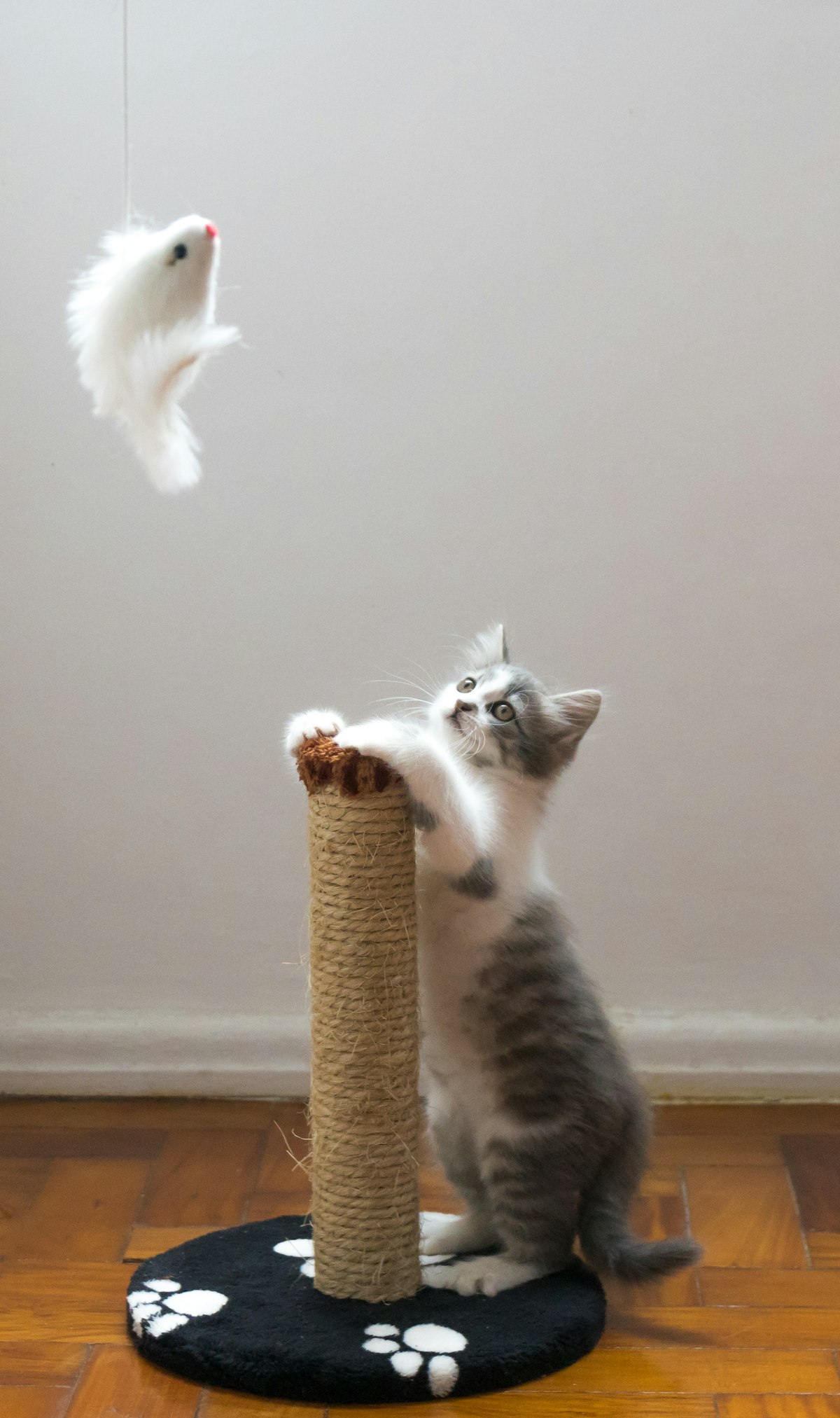
Dedicate 15 minutes daily to active play with a wand toy. The key word is “active”—you’re mimicking the movement of prey. Drag it under blankets, through doorways, make it act like a scared mouse. Your cat should be stalking, pouncing, and occasionally “catching” the toy.
**The window entertainment station:**
Set up a bird feeder outside a window with a perch. Birds can keep cats mesmerized for hours. If you can’t install a feeder, even a bird feeder visible from inside works wonders.
**Rotating toy collections:**
Cats get bored with the same toys. Keep a collection of 10-15 toys, but only put out 3-4 at a time. Rotate them every few days so everything feels “new” again.
**The hunt and gather approach:**
Instead of one big meal, split your cat’s daily food into 4-5 small portions hidden around the house. This turns eating into exploration and rewards natural foraging behavior.
## The Senior Cat Factor
I want to single out senior cats because this is something people often overlook. As cats age, they naturally become less active, and we tend to feel sorry for them—maybe even reduce their stimulation even more.
Big mistake.
Research from the University of California Davis shows that senior cats who engage in regular mental stimulation—puzzle games, gentle play sessions, environmental exploration—maintain cognitive function significantly better. One study showed that enriched senior cats had **brain tissue equivalent to cats 2-3 years younger** than their actual age.
Even for cats with arthritis or mobility issues, there are ways to provide mental enrichment. Soft, plush toys that they can bunny-kick, treat-dispensing balls they can nudge with their nose, or simply talking to and interacting with them throughout the day.
## The Investment That Pays Off
Here’s what I’ve learned: time spent enriching your cat’s environment isn’t just entertainment—it’s an investment in their health and your relationship.
The cost of a good puzzle feeder? Maybe $15-30. Compare that to veterinary bills for stress-related illness, obesity treatment, or behavioral modification. Or the heartache of surrendering a cat because “she’s just too destructive.”
Your cat isn’t being difficult or demanding. She’s being a cat. Those behaviors that frustrate us—knocking things off shelves, attacking our ankles, meowing at 3 AM—are often cries for engagement.
Give her the mental workout she needs, and you’ll have a happier, healthier, better-behaved companion. And honestly? Watching a cat engaged in “the hunt” is one of the most entertaining things you’ll ever see. It’s like having a tiny, furry predator who’s completely into the performance.
What’s your cat’s favorite enrichment activity? Drop a comment below—I love hearing about creative cat enrichment solutions.